

Database Clusters with Replication, Failover, and ProxySQL Built In
Deploy SQL and NoSQL clusters from the dashboard, with no manual replication setup or failover scripting. MySQL, MariaDB, PostgreSQL, Redis, and OpenSearch all include automated replication, failover, and NVMe SSD storage.
Deploy from the control panel. Replication, node discovery, and load-balancer wiring configured on provision.
Platform monitors track node health across all topology types — Primary-Secondary, Primary-Primary, Galera, XtraDB, and Redis.
Sits between your app layer and database nodes. Routes reads to replicas, writes to primaries — no application changes.
Cluster topologies deploy pre-wired: replication rules, failover triggers, and proxy configuration included.
Choose the cluster configuration that matches your access pattern
Primary + replicas (SQL)
Great default for most production apps: fast writes, straightforward failover, and easy read scaling. Available for MySQL, MariaDB, PostgreSQL.
Multi-primary / Galera (SQL)
Every write is confirmed on every node before it completes, which gives you full write availability and strong fault tolerance. Available for MariaDB (Galera) and Percona (XtraDB).
Redis Cluster (NoSQL)
Distributed in-memory key-value store with automatic sharding and failover. Ideal for caching, sessions, and message brokering at scale.
OpenSearch Cluster (NoSQL)
Distributed search and analytics with automatic node discovery. Add Dashboards, Logstash, and Beats for log aggregation and analytics.
Run SQL clusters with automated replication and failover
Primary-Secondary Replication
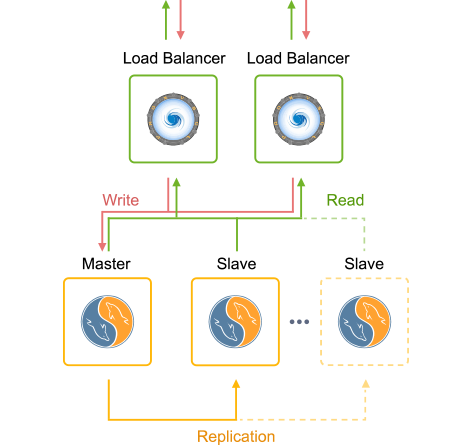
Read scaling
Scale reads by adding replicas from the dashboard, with no replication configuration required.
Offload analytics
Route analytics and reporting queries to replicas so the primary stays responsive.
Backup from replica
Run backups from a replica with zero impact on production write traffic.
Primary-secondary is the most common configuration. One node handles writes; replicas serve reads, keeping write pressure off the primary.
Multi-Primary Replication
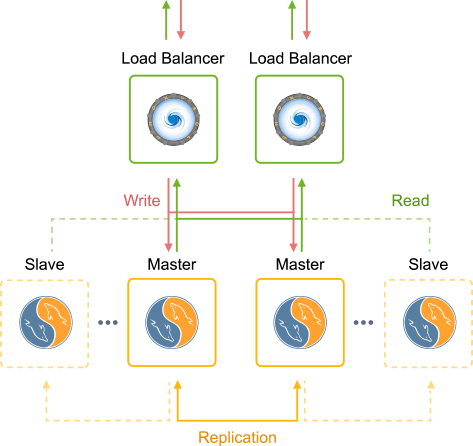
Write throughput
Writes spread across both nodes instead of queuing on one, which improves throughput for write-heavy apps.
No promotion delay
If one primary fails, the surviving node keeps accepting writes with no promotion delay.
Multi-region DR
Replicate across regions for disaster recovery and lower-latency reads.
Multi-primary gives you two writable nodes with ProxySQL routing reads and writes between them.
Galera / XtraDB (Synchronous Multi-Primary)
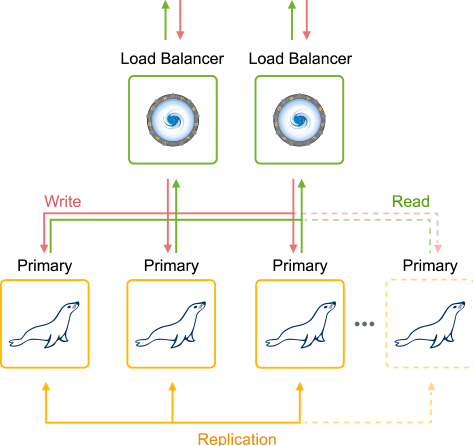
Any-node writes
Point your app at any node for reads and writes, with no read/write splitting required.
Fault tolerance
Lose a node and the remaining nodes continue serving traffic with no data loss.
Flexible cluster scaling
Add or remove nodes from the dashboard without application changes.
Galera and XtraDB use synchronous multi-primary replication. Every write is confirmed on all nodes before it completes, so all nodes hold identical data.
Upgrade clustered databases with data preserved.
Redeploy dialog shows a MariaDB Galera cluster moving to a newer version with sequential rollout.
PostgreSQL Primary-Secondary
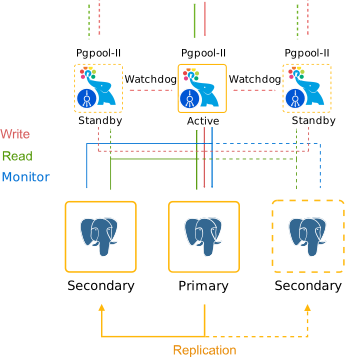
Automatic cluster setup
Deploy via automatic cluster setup or the marketplace one-click installer.
Pgpool-II
Pgpool-II sits between your app and the cluster, making connection management and failover invisible to application code.
Scale out
Add standby nodes and the platform handles replication and load-balancer registration automatically.
PostgreSQL clusters use WAL (Write-Ahead Log)-based asynchronous replication with Pgpool-II for connection pooling, query distribution, and automatic failover.
Scale NoSQL with Redis, OpenSearch, and Couchbase clusters
Redis Cluster
Each primary node pairs with a replica for read distribution and automatic recovery if the primary goes down.
- Minimum 6 nodes (3 Primary + 3 Secondary), scalable to 12
- Automatic resharding and rebalancing when nodes are added or removed
- Optional auto-scaling triggers based on CPU/memory load
- Use cases: caching, session storage, message brokering, real-time analytics
OpenSearch Cluster
Distributed search and analytics engine with automatic node discovery. Start with a single node and scale horizontally as index volume grows.
- Optional OpenSearch Dashboards for data visualization
- Optional Logstash for data processing pipelines
- Beats data shippers for collecting logs and metrics from application nodes
- Use cases: application search, log aggregation, analytics dashboards
Couchbase Cluster
NoSQL document store with one-click deployment. Nodes join the cluster and data automatically rebalances across them as you add capacity.
- Up to 10 nodes with automatic horizontal scaling
- Built-in SQL-like query engine (N1QL) for flexible data access
- Full-text search, indexing, and eventing included
- Use cases: large-scale applications, low-latency data management, mobile backends
Deploy your NoSQL cluster in minutes
Redis, OpenSearch, and Couchbase clusters deploy with automated replication and dashboard-managed scaling.
Get auto-discovery, admin panels, and failover on every cluster
Auto-discovery on scale-out
Add nodes from the dashboard. New nodes join the cluster, configure replication, and register with the load balancer automatically.
phpMyAdmin with IP restrictions
Each SQL node includes phpMyAdmin. Lock access to specific IPs or keep it internal-only with Apache rules, so you do not need a separate bastion server.
Cross-region failover
Place multi-primary MariaDB nodes in separate regions. If one region goes offline, the surviving node keeps serving reads and writes with no manual promotion.
Extend your cluster with operations add-ons
Cluster recovery
When a node fails beyond automated failover, the recovery add-on deploys a replacement, syncs replication state, and rejoins it to the cluster. Covers Primary-Secondary, multi-primary, Galera, and XtraDB configurations.
Scheduled backup/restore
All clusters include 14 days of daily restore points. Schedule additional backups on a custom cron cadence. The add-on coordinates cluster-aware backups (Galera quorum-safe) and validates integrity before completing restores.
Corruption diagnostics
Automated integrity checks run across MySQL, MariaDB, and Percona instances, whether standalone or clustered. They catch corruption before it reaches production queries.
SSL/TLS encryption in transit
Enforce encrypted client connections with platform-issued server and client certificates. This covers MySQL, MariaDB, and Percona, including ProxySQL-encrypted backend replication traffic. See Security Overview for the full isolation and encryption model.
Add operations coverage to any cluster
Recovery, scheduled backups, diagnostics, and SSL encryption are available as add-ons for any cluster configuration.
Restart clustered databases without dropping everything at once.
Restart dialog shows sequential node restarts with delay.
Decide if a managed cluster fits your workload
Best fit
- Production workloads where a single database node is a single point of failure
- Applications that need read replicas separate from the write primary
- Compliance environments requiring encrypted connections and controlled backup retention
- Teams that want HA database architecture without custom replication engineering
Consider instead
- Single-node dev/staging databases: Deploy a standalone database on App Hosting without clustering.
- Infrastructure-layer control: Deploy on Cloud VPS with your own database install.
Database clusters power WordPress Cluster setups. See the Managed Database page for all supported engines, or pair clusters with App Hosting for managed application deployments.
Common Questions
Which database engines support clustering?
Supported SQL engines are MySQL, MariaDB, PostgreSQL, and Percona. Supported NoSQL engines are Redis (distributed cluster), OpenSearch (auto-clustering), and Couchbase (auto-scalable cluster). See topology options below.
What tasks are managed by Togglebox?
Togglebox provides the platform and control-panel automation (auto-configuration and staggered restarts/upgrades). Your team provisions clusters, starts maintenance actions, and owns schema, data operations, and release workflows. See the Statement of Support for scope details.
Can you help with high-availability architecture?
We can help design failover-ready layouts based on your workload profile and growth plan. Reach out for a recommended starting architecture.
Where can I compare platform options?
Use PaaS vs VPS to compare managed app patterns versus direct infrastructure control.
What replication modes are available for MySQL and MariaDB?
Primary-Secondary replication supports read scaling and failover. Primary-Primary supports write availability. Galera/XtraDB provides synchronous multi-master clustering.
Are database backups included?
Yes. Every database gets 14 days of daily restore points. An optional Backup/Restore add-on lets you set custom schedules and store backups on remote storage for longer retention.
How does auto-clustering work for databases?
Enable auto-clustering in the topology wizard to provision a preconfigured cluster (Galera for MySQL/MariaDB, replication for PostgreSQL, and native clustering for Redis and OpenSearch). The platform handles initial setup, configuration distribution, and staggered restarts during upgrades.
Can I clone a database cluster for staging tests?
Yes. Clone environments for release rehearsal and migration tests before touching production. Validate replication mode, failover behavior, and connection settings in the clone first.
No matching questions found.
Start your 14-day free trial
Deploy in minutes with managed autoscaling and clustering built in.
No credit card required.